AI Audio
What Is an Audio Content Engine and Why It Beats Raw TTS
If you’ve looked at adding audio to your content, you’ve probably run into text-to-speech tools pretty quickly. Paste in some text, pick a voice, download an MP3. It works. The question is what happens next — because that’s where raw TTS stops and where an audio content engine starts, and the gap between them is […]
If you’ve looked at adding audio to your content, you’ve probably run into text-to-speech tools pretty quickly. Paste in some text, pick a voice, download an MP3. It works. The question is what happens next — because that’s where raw TTS stops and where an audio content engine starts, and the gap between them is most of the actual work.
What raw TTS does
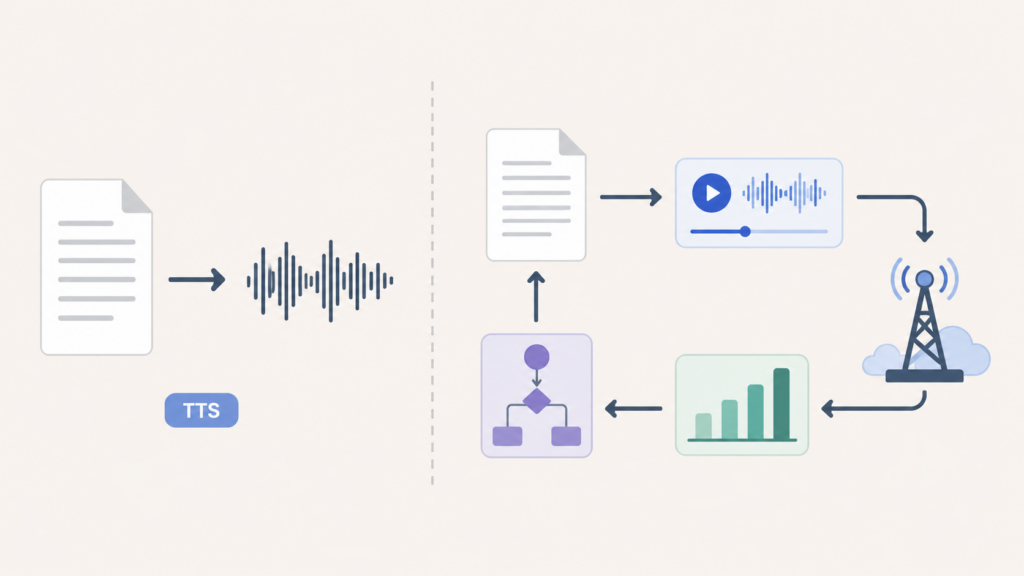
Text-to-speech is a conversion layer. You give it text, it gives you audio. That’s genuinely useful and the quality of the voice output has improved dramatically over the last few years to the point where a good TTS voice is indistinguishable from a competent human narrator for most listening purposes.
But the output is a file. What you do with that file — how you host it, serve it, embed it, track it, update it when the article changes, manage it across hundreds of posts — is entirely your problem. Raw TTS has finished its job the moment it hands you the MP3.
For a one-off use case that’s fine. For a content publisher producing audio at scale, it’s where the real work begins.
What an audio content engine does differently
An audio content engine treats audio as a content channel, not a one-time export. The conversion from text to speech is one step inside a bigger system, rather than the whole product.
The meaningful differences sit in five areas.
Generation that fits the workflow. Rather than manually triggering a conversion every time you publish, an engine connects to where your content lives — your CMS, your WordPress install, your RSS feed — and generates audio automatically when a post goes out. Publish an article, audio appears. No extra step, no queue to manage.
Storage and delivery off your infrastructure. A raw MP3 sitting on your own server is a liability at scale. Audio files are large, concurrent listeners put load on the server, and you’re paying hosting costs for every play. An engine stores and delivers the files from a CDN built for media, so your site isn’t doing that work and your readers aren’t waiting on it.
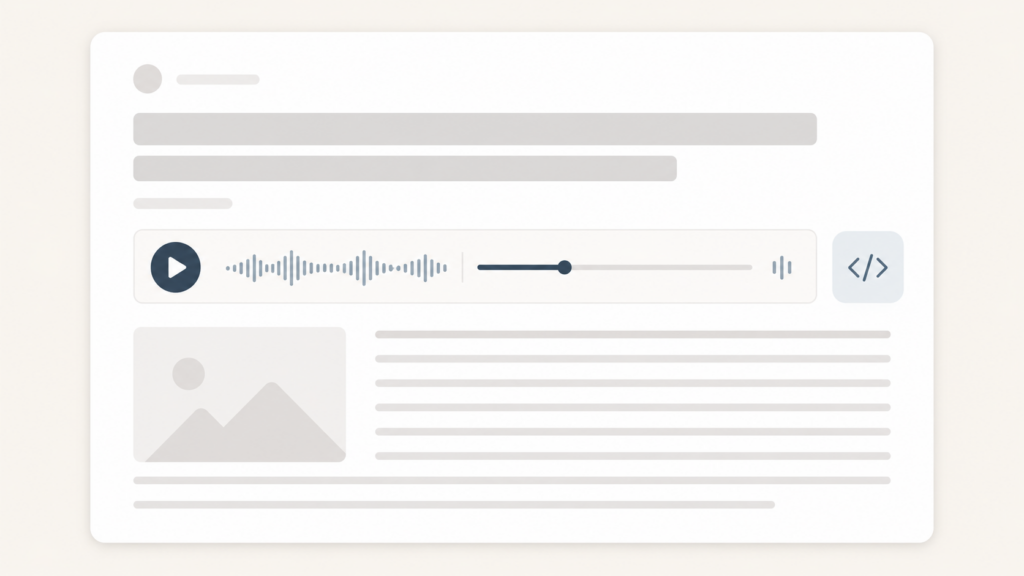
An embeddable player, not just a file. A file needs a player. Building your own player, keeping it lightweight, making it match your brand, ensuring it works across email clients and mobile browsers — that’s a non-trivial engineering job if you approach it from scratch. An engine ships the player as part of the package, usually as a snippet or a plugin that drops in without custom dev work.
Version control when content changes. Articles get updated. A correction goes in, a paragraph gets cut, the intro gets rewritten. With raw TTS, the audio version is immediately stale and you have to regenerate it manually and re-upload it. An engine tracks the relationship between the article and its audio, so when the source changes, a new version gets queued and the old one gets replaced automatically.
Listening data. An MP3 tells you nothing. An engine captures what actually matters: whether people pressed play, how far they listened, which posts get the most audio engagement, and whether audio listeners behave differently from readers. That data is what lets you decide whether audio is working and what to do next with it.
Why the distinction matters in practice
The easiest way to see this is to trace what happens when a mid-sized publisher — say, a team producing thirty articles a month — tries to add audio using raw TTS versus an engine.
With raw TTS, someone has to convert each article manually, probably thirty separate jobs a month. The files go somewhere, probably the media library, probably unorganised. The player is a default HTML5 element or a hastily installed plugin. When an article gets updated, the audio version may or may not get updated too. After six months there’s a backlog of stale audio files and no clear picture of whether anyone is listening.
With an engine, audio generation happens on publish without anyone managing it. The files are hosted and delivered by the engine’s infrastructure. The player loads fast and looks consistent. Updated articles get refreshed audio automatically. At month six the team can pull a report showing exactly how many hours of listening they’ve driven and which topics perform best in audio format.
One is audio as a feature someone bolted on. The other is audio as a real content channel. The underlying voice quality might be identical. The operational difference is substantial.
When raw TTS is actually fine
It’s worth being honest here. If you’re publishing occasionally, testing whether your audience wants audio at all, or producing audio for a single one-off project, raw TTS is the right call. It’s cheap, it’s fast, and it doesn’t require setting up anything. You export a file, embed it, done.
The point at which it stops being enough is roughly when manual management becomes its own job — when you’re spending meaningful time on audio logistics rather than content. That’s when the cost of an engine starts making more sense than the cost of the time it saves.
The short version
Raw TTS is a voice. An audio content engine is a publishing system that happens to include a voice. For occasional use, the voice is all you need. For a content operation where audio is meant to be a consistent part of what you ship, the rest of the system is what makes it actually work. If you want to see what that looks like in practice, our article-to-audio setup is built around that end-to-end model rather than just the conversion step.
FAQ