Guides
Text to Speech vs a Full Audio Publishing Platform: What Is the Difference?
Many teams start with a simple text-to-speech question: can we turn an article into spoken audio? That is a reasonable starting point, but it is only one piece of the publishing problem. A text-to-speech tool can produce speech. A full audio publishing platform is designed to manage how that speech becomes part of the reading experience, workflow, and reporting layer of a content operation.
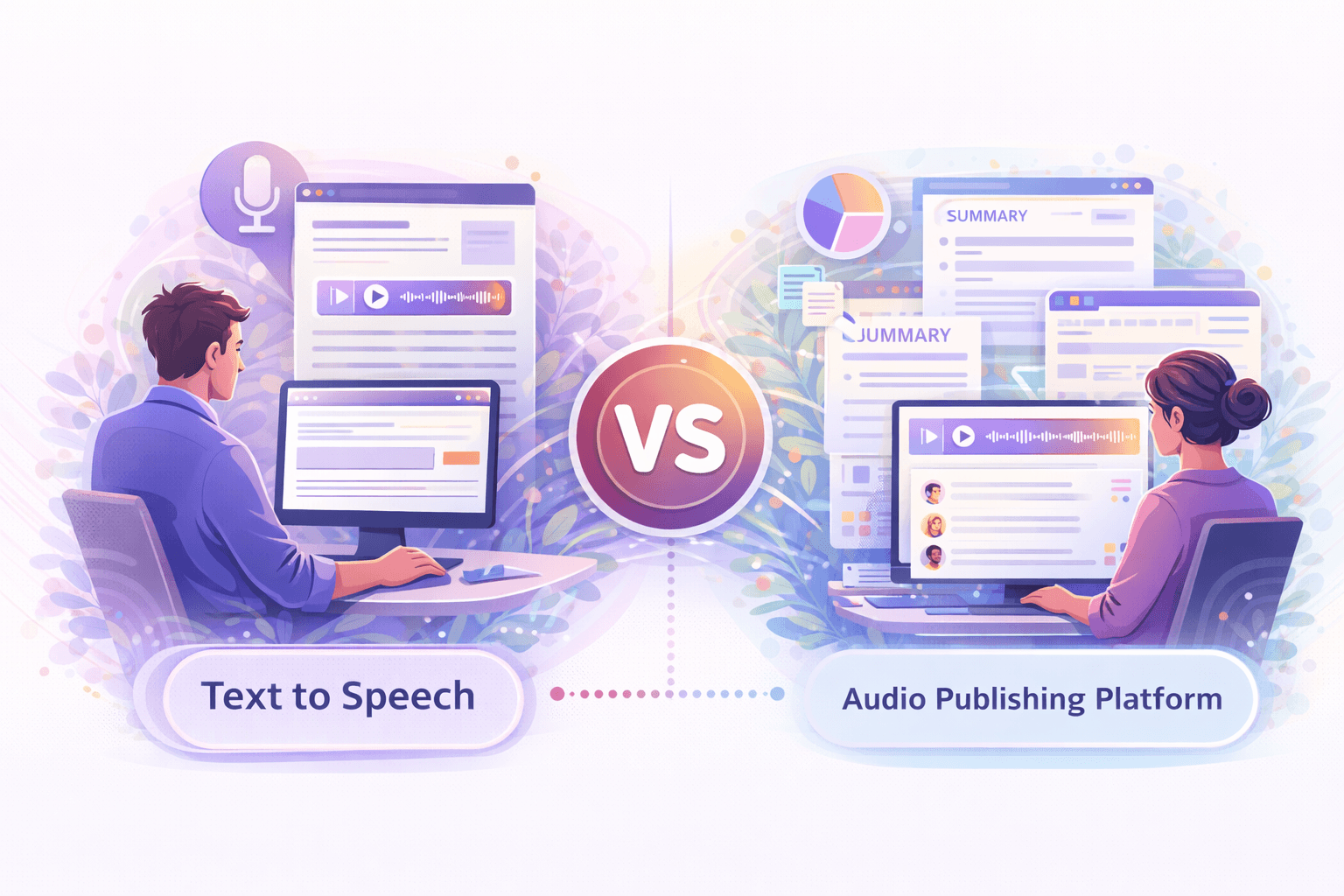
This distinction matters because publishing teams are not buying raw speech output alone. They are buying a usable system.
Text to speech solves one narrow problem
Basic text-to-speech tools are focused on generation. You provide text, choose a voice, and receive audio. That is useful, but it leaves many publishing questions unanswered. Where does the player live? How is the article page structured? What happens when the article changes? Can readers control speed? Is there a transcript? Can performance be measured?
Without answers to those questions, the team may still have speech files, but not a real product experience.
Publishing platforms are built around the article experience
A full audio publishing platform starts from the article page and works outward. It considers the embedded player, summaries, transcripts, multilingual versions, analytics, and integrations with the wider content workflow. It is not just concerned with producing a file. It is concerned with making that file useful.
That broader design is what allows publishers to scale audio across different types of written content. The platform supports consistency, governance, and measurement in ways a standalone generation tool usually does not.
Workflow and operations are a major difference
Teams often underestimate the operational gap between speech generation and audio publishing. Generating one file for one article is easy. Managing audio across dozens or hundreds of articles, with updates, multiple voices, analytics, and feature access by plan, is far more complex.
A publishing platform reduces that operational burden by connecting generation, playback, metadata, and reporting in one system. That is especially important for publishers that need reliable processes rather than one-off experiments.
The user experience is where the value becomes visible
Readers do not care how many backend services were involved in generating the audio. They care whether the page feels useful, clear, and trustworthy. A platform that includes summaries, transcripts, polished controls, and reliable playback creates a much stronger impression than a simple widget wrapped around a speech file.
That user experience is where the difference becomes visible. It is also where teams start to see the commercial value of doing audio properly.
Conclusion
Text to speech is a capability. A full audio publishing platform is a product layer built around that capability. The difference is not academic. It affects workflow, usability, measurement, and scalability.
For teams that want article audio to become a meaningful part of publishing rather than a side experiment, a full platform is the stronger long-term approach.