AI Audio
How AI Voice Summaries Turn Long Articles Into 2-Minute Listens
Most people who land on a long article don't read it. They scan the intro, jump to a subhead, decide whether it's worth their time, and usually decide it isn't. That's not a writing problem. It's a time problem. A 1,800-word piece is a real commitment, and a lot of readers want the payoff without the eight minutes. An audio summary fixes that by giving them a third option. Not "read the whole thing" or "leave," but "press play and hear the gist in two minutes." It's the same instinct behind a TL;DR at the top of a post, except they can listen to it on the train, while making coffee, or with their eyes somewhere else entirely.
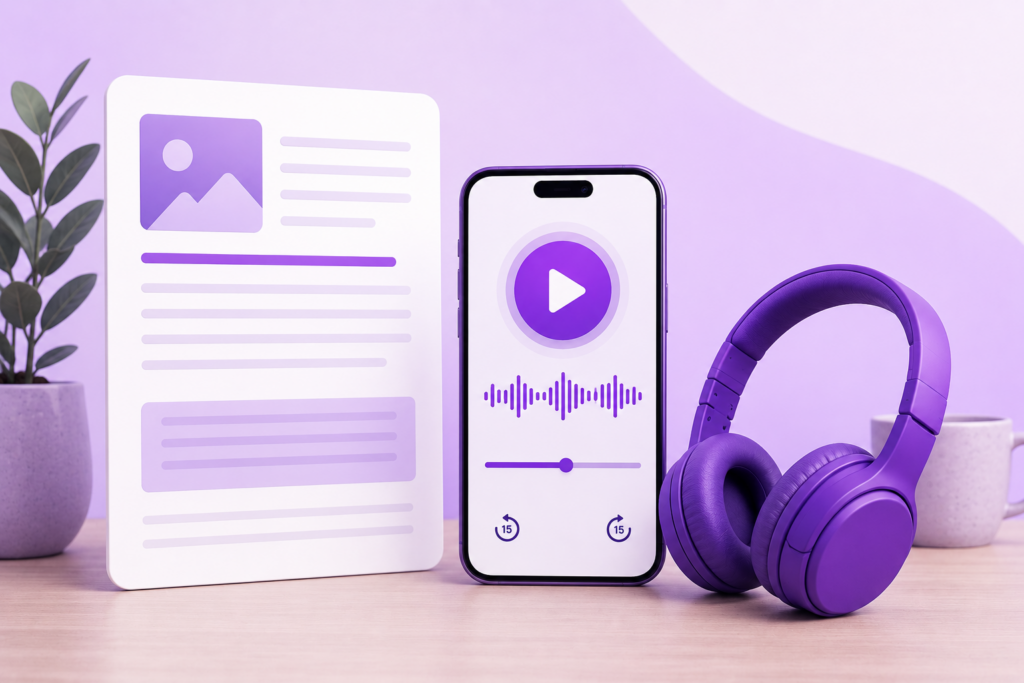
This post is about how that works, where it actually helps, and where a summary is the wrong call.
What an audio summary actually is
There are two distinct things people mean when they say "listen to this article," and it's worth keeping them separate.
The first is a full narration: the article, read start to finish, in a natural voice. Nothing is cut. A 1,800-word piece becomes maybe ten or eleven minutes of audio. This is what most "listen to this article" buttons do today, and it's great for people who genuinely want the whole thing but prefer to listen.
The second is a summary: the article compressed down to its core points, then narrated. The same 1,800 words might become 300, which is roughly two minutes of audio. The reader gets the argument and the conclusion without the supporting detail.
Both are useful. They serve different moments. Someone deep in research wants the full read; someone deciding whether to care wants the summary. The mistake is offering only one and assuming it covers everyone.
How the summary gets made
The pipeline is less mysterious than it sounds. The text of the article goes to a language model with instructions to condense it while keeping the actual claims intact, not just the topic sentences. That summarized text is then sent to a text-to-speech voice and rendered as audio. The output is a short clip that sits in the player alongside the full version, usually behind a toggle.
The part that matters, and the part that's easy to get wrong, is the summarization step. A bad summary keeps the throat-clearing and drops the substance. A good one does the opposite: it cuts the windup, the caveats, and the third example, and keeps the thing you'd actually tell a colleague if they asked what the article said. Getting that right is mostly about the prompt and the model, not the voice.
One detail worth knowing if you're publishing these at scale: you don't want every reader's click to regenerate the audio from scratch. The summary and its narration should be generated once when the article is published (or updated) and then cached, so the hundredth listener gets the same file instantly. We go deeper on the summary-and-transcript side of this in our guide to AI audio summaries.
When a summary earns its place
Summaries are not a universal upgrade. They're a specific tool for a specific reader.
They work well for news and analysis, where the reader mostly wants to know what happened and what it means. They work for newsletters, where someone's catching up on five issues and wants the highlights. They work for long explainer or opinion pieces, where the argument compresses cleanly even if the prose doesn't.
They're a poor fit for anything where the detail is the point. A step-by-step tutorial summarized into "install the thing, configure it, deploy" is useless. A legal or medical piece where the qualifications carry the meaning can be actively misleading once compressed. Narrative writing loses whatever made it worth reading. For those, offer the full narration and skip the summary, or don't offer audio at all.
The honest version of the pitch is this: a summary captures readers you were going to lose anyway. The person who would have read every word still can. The person who was about to bounce now has a two-minute option. You're not cannibalizing your full reads. You're catching the ones already heading for the exit.
What to measure once it's live
If you add summaries, watch two things before you decide whether they're working.
The first is whether people use the summary at all, and which version they pick when both are offered. If the summary toggle gets almost no plays, your audience wants the full read, and that's fine to know. If it gets most of the plays, you've found real demand for the short version.
The second is completion. A two-minute clip that people finish is doing its job. A ten-minute full read that everyone abandons at the ninety-second mark is telling you those listeners wanted a summary and didn't have one. The drop-off point is the signal.
The short version
A summary is the audio equivalent of letting someone skim. Some readers will always want the whole article, and you should keep serving them. But a lot of people aren't choosing between your full piece and a shorter one. They're choosing between two minutes of your article and none of it. Giving them the short listen is how you turn that second group into an audience instead of a bounce.
FAQ